Forums > General Chat
Lelan

Customized Sewing Stations/ Sewing Rooms

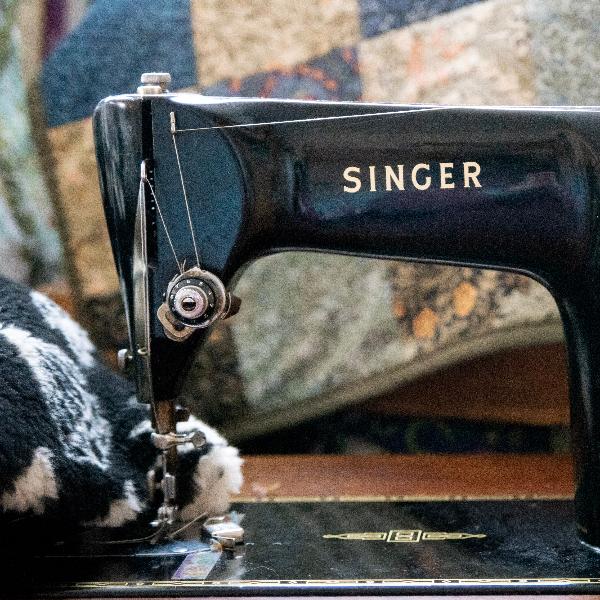
I am almost finished with a retro-fitting project on an old sewing table that I couldn't find a machine machine for. It is very sturdy with plenty of drawer space, and the kind of work station geography that invites customization. Into this work station, I have dropped a 1927 Singer 99 (manufactured April 23rd, 1927 - in a few days, I will have a 99 that is 99 years old) which has been equipped with a hand crank. I don't have many photos of it yet (because it isn't finished) but I can share a couple pictures of some of my favorite details.

Anyway, what kind of DIY long-term renovations have you made to a space or a workstation for no reason other than your own sheer enjoyment of it?

· 1 month ago
You must have an account to comment or reply on threads - please log in or join the community.
Sort replies by:
SewHayleyJane's avatar
SewHayleyJane Admin

This sounds amazing!! Excited to see more as it develops.

I’m not much of a renovator myself, I tried to upcycle a desk once and am ashamed to say it never got finished!

· 1 month ago
Lelan's avatar
Lelan

But - you can say you took it on while unsure of the outcome. More than most can say. Thank you for the compliment and the encouragement, Hayley.

· 4 weeks ago
SewHayleyJane's avatar
SewHayleyJane Admin

That is definitely one way of looking at it! Sadly it ended up in the household recycling centre but the enthusiasm was definitely there at the beginning.

· 4 weeks ago
Lelan's avatar
Lelan

Here are some more photos. I wanted to really make the most of the acknowledgment of the extent to which rationing schemes and Make Do and Mend mentality really shaped both American and British household economics from 1939 all the way into the 50s. The work station itself is finally settled in its permanent place of duty alongside the display of my private collection of 100+ year-old sewing machines, to turn what was once whatever was left of a linear wall space in a space that is both cozy and open. Please enjoy, and feel free to ask any questions you might have. (By the way, yes, the official "Make Do and Mend" booklet from the UK and its American counterpart, "Make and Mend", are both 100% complete and authenticate, and I think they capture the era I am paying homage to and the intent of the work space perfectly well.)

· 4 weeks ago
SewHayleyJane's avatar
SewHayleyJane Admin

This is fantastic, it's like your own private museum! Is that a teeny tiny sewing machine on the desk?! Where do you find them all?

· 4 weeks ago
Lelan's avatar
Lelan

Excellent eye! Yes, that is a 1926 Singer model 20. It is not a toy but a simple, direct-drive chain stitch machine meant for children to learn and sew with until they grew up, went to college, and found their ways into homes of their own with full size machines to use. Singer made it very clear that these were very real machines intended for very precise hemming and similar 2-dimensional sewing projects.

And yes - it is very much like my own personal museum... and I am exceedingly grateful to have it as such.

Admittedly, I find most of the machines online through Etsy and online auction sites. Most of the ones I find and bring in have finishes that are too far gone for the "purists", but those are exactly the machines I want to find and preserve - the faithful and steadfast workhorses that bear the scars of their age, service, and misuse and yet still carry right along, happy for the chance to be brought out of squalor.

· 4 weeks ago
AnnieRose's avatar
AnnieRose

These are amazing and lovely. I had a 1950s miniature machine to learn on (long since passed on to others) before I had the use of my mother's.

· 4 weeks ago
Lelan's avatar
Lelan

Thank you, Annie. That was a fine accounting of passing along worthwhile things such as skill, knowledge, and appreciation of genuine value.

· 3 weeks ago
SewingandDoggos's avatar
SewingandDoggos Plus Member

! A fellow restorer and collector in the wild!

My workaday machine is the Singer 201k aluminium in a short bottom of the range cabinet, but also I have…every single variant of the 66k in both full and 3/4 size ranging from the first 66k with the lotus decal to the 275 which is exactly as horrible as everyone says it is. Kept as hand crank if the cranks have decal but I swap out motors for a brand new YDK motor as default

My machines are not mint mint but close enough and all bought for under £30, I do preservation on the japanning rather than full paint jobs using warhammer nerd paint in black which is the same colour as singer black to prevent any chips from getting worse. I have absolutely not used a nail gun at any point to fix any bases, oh no not me.

Did you know the singer 201k’s full rotary hook is a perfect match for maraflex without having to touch the tension? Just me French seaming knit t-shirts on a straight stitch machine while cackling wildly.

· 3 weeks ago
Lelan's avatar
Lelan

There's is nothing like feedback from an exuberant fellow nerd who obviously loves what they do. Cheers! I myself, when I have the chance to make repairs to a wooden base, also shun compressors and air tools. I have yet to find one that I would be comfortable with simply hammering in new brad or finishing nails (unless it's a new piece of wood for a modification), and I certainly always find ways of creating redundancy at every joint if I can. I seal everything wood with oils: teak, linseed, or butcher block.

I haven't really tied in to my private collection to need to get into the paint/ finish aspect of things yet. (I collect for myself machines too esthetically compromised to be wanted by anyone else, but that have great worth in terms of historical glory.) I am getting close to closing off my vintage/ antique sewing machine redistribution program, where I serviced and stabilized various machines for donation to a local thrift store to give others access to them for more affordable prices. Now, I am able to turn my focus to my own collection and begin the more in-depth work of preserving what is there.

Your reply brought a smile to my face, "hearing" your excitement for your work, and also brought great information and helpful tips. Thank you very much and again, cheers!

· 3 weeks ago
SewingandDoggos's avatar
SewingandDoggos Plus Member

This is the second collection I’ve owned in the last 25 years, the first was super super random car boot sale machines bought for next to nothing and had all sorts of wonderful stuff in it from early shuttle machines to the 201k which is the only one from that era I kept. I ended up donating them as working to a cool local homeless charity.

This class 66 collection I’ve only had for two years and it was an actual planned thing with a list and everything and it’s because the 66k has everything from the first version with fixed foot, early tension disks and stitch length lever with no numbers and it evolves all the way to the last 99k with the 201k reverse gear on it. That last 99k you can find on eBay In near mint condition for £20 any day of the week and is the one I’d recommend to people reading this thread looking to get into vintage.

This is the oldest one I now have and again only £20

· 3 weeks ago
Naomijane's avatar
Naomijane

I have a question about vintage sewing machines now that I've found two experts!

Is it okay to continue using an old machine (if it works), or should its use be limited? I have a 1907 Jones which works perfectly and I've made a lot of clothes with it, but I worry that I'll be the one to finally finish it off! I oil it whenever I replace the bobbin, but I'm not sure what other maintenance it needs?

Beautiful collection by the way Lelan. My own includes my great grandmother's 1919 Hexagon (which my sisters and I learnt on), a 1950s Singer treadle, the 1907 Jones and more recently a 1960 hand crank Singer. Oh and a modern Janome from John Lewis (for button holes and zips!).

· 2 weeks ago
SewingandDoggos's avatar
SewingandDoggos Plus Member

Use it, you won't break it it's fine, and oiling it is all it will ever need :) The metal they used back then does not even exist in mass manufacturing today, it's just an order of magnitude harder with no flaws or defects, basically the highest grade modern medical metal just about comes close. We know from metallurgy tests that you could use a Jones/Brother or a Singer machine from that era 24/7 for 500 years and the feed dogs would remain just as sharp, where problems come in is not using it. The oil gets solid, rust gets in and then bits snap when people try and force it to unfreeze.

My number 1 advice with old machines is that Toyota still make the motors today for £50 under the YDK brand, and all you do is undo a single bolt on the back of the machine to install them which means you only need one and can swap it out between machines when needed.

· 2 weeks ago
Naomijane's avatar
Naomijane

For 500 years?! That's incredible! Thank you for that, I shall continue using it then minus any guilt!

· 2 weeks ago
Lelan's avatar
Lelan
— Post Deleted — · 2 weeks ago
Lelan's avatar
Lelan

I agree with SewingandDoggos. These things are by no means fragile under normal conditions. The true heirloom machines were made from the same materials and techniques that built the machines that made them. Victorian and Edwardian iron machines were a huge investment and were made to instill and reflect the timelessness and rugged durability that the manufacturers wanted their customers to see as traits of the companies themselves. Aside from blatant mistreatment or drops/ falls that crack the body, the mechanical parts and mechanisms of your old machines actually do best when consistently used. Great question!

· 2 weeks ago
Lelan's avatar
Lelan

I have, in all actuality, a YouTube channel: https://www.youtube.com/@livingandactive116

If you go there and look around for the "Motel's New Machine" playlist (and subject heading in the Posts tab) you will see many examples of my explorative and restorative exploits thus far.

An open invitation to any who would be interested. There are many varied subjects that appear in the content of that channel, so you may even find some non-sewing or -sewing machine related media to enjoy.

· 3 weeks ago

Join the community!

Sewing doesn't have to be solitary.

ThreadySetGo is a vibrant and welcoming space for sewists of all ages and skill levels.

It's completely free to get started!

Verify Your Email

Before being able to interact with the community you must verify your email account so we know you're a real human being!